 Spanish
This website uses cookies so that we can provide you with the best user experience possible. Cookie information is stored in your browser and performs functions such as recognising you when you return to our website and helping our team to understand which sections of the website you find most interesting and useful.
Automatic warehouse modernizations
In the 90's the first automated storage warehouses were put into operation, since then the implementation of automated warehouses in the Iberian Peninsula has grown exponentially.
Today in Spain the number of automated warehouses exceeds a thousand.
The moment an installation is put into service it is subject to constant, general changes such
as the following:
Component obsolescence ➔ Spare parts.
New operational requirements ➔ System adaptations.
Physical adaptations.
Adaptations of WMS, PLC.
Management systems unable to adapt to new changes ➔ Migrations.
Business growth ➔ Expansions.
Fundamental modifications of the installation ➔ Changes in consumption models.


In addition, an automatic warehouse is not a very flexible system. It works well under specific initial parameters, but when any of these parameters present deviations, the system stops responding adequately and it is necessary to take action. These deviations can be produced by the following factors: Increase in the number of references Changes in the morphology of orders Number of lines/orders Number of units/lines Addition of delivery routes Addition of distribution channels Introduction of e-commerce orders
Integrators are generally not capable or sized to support their customers throughout the life cycle of their automatic installations. This support requires in-depth knowledge of internal logistics, automation and, above all, the ability to react quickly and effectively.
We also notice that the maintenance provided by the integrator is often expensive and the
level of service is not particularly effective.
The most critical aspect is that the user is entirely dependent on the integrator to handle trivial aspects of his daily work operations. To carry out operations such as the following, they must go through the installer's TAS:
Resetting a particular operating zone
Move a load unit through the WMS or MFC
Withdraw a loading unit and relabel it
Remove load units from the system
Delete virtual locations in the conveyor system that are generated during daily operations
In addition, devices installed originally are often held captive by Firmware (the program that physically manages the device) and some spare parts are unique to the installer. This, in effect, means that the cost of these spare parts is exorbitant.

How do we take care of this?
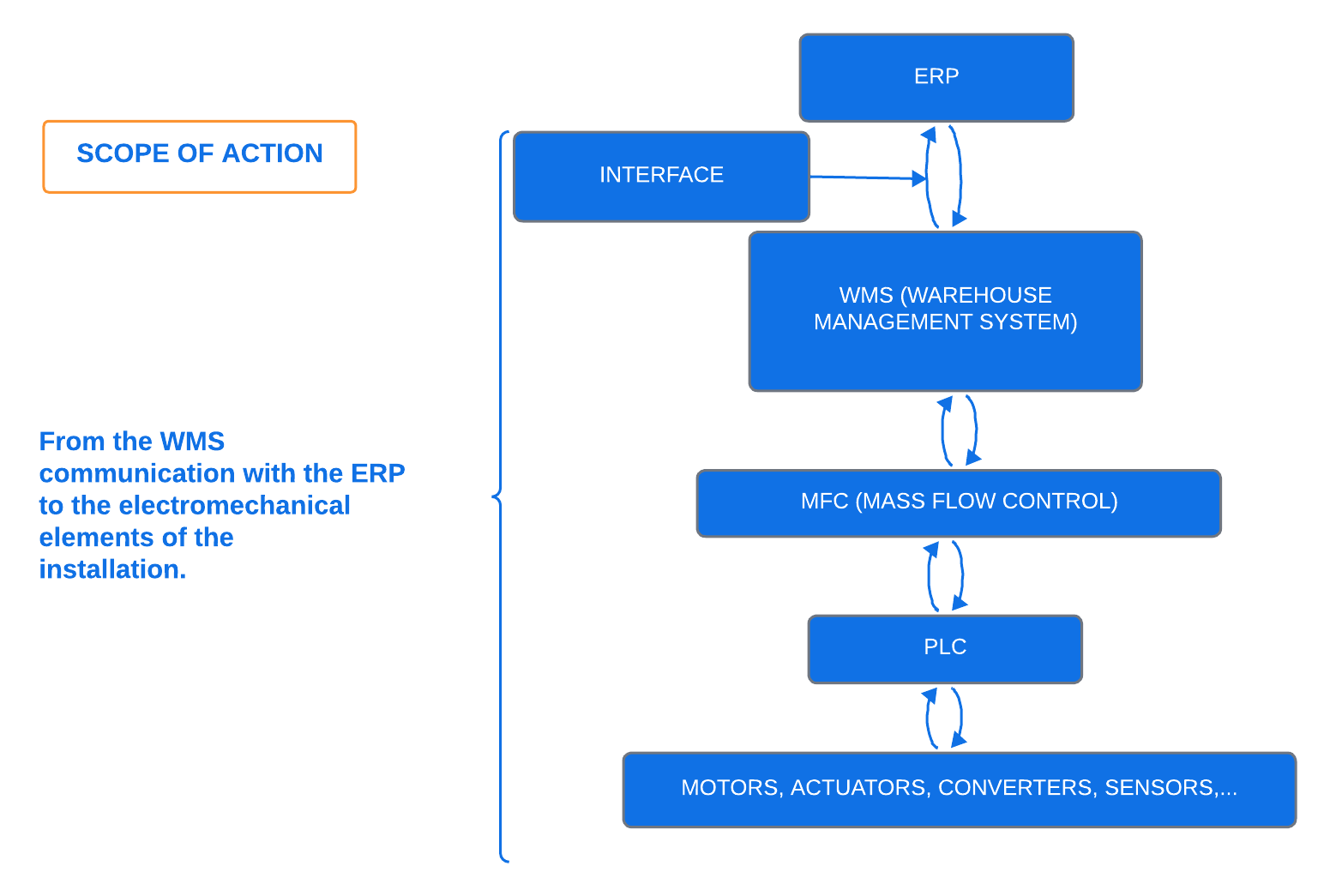
Working 'segment by segment' in previously defined logical zones during the time slots with no operational activity.
The 'segment by segment' model is carried out in the following way:
1. The defined zones are switched off during installation downtimes
2. The new control program is installed.
3. New components are added and linked to the new control program.
4. Functional and communication tests are carried out
5. We check that everything is working correctly
6. We reconnect with the initial values so that the daily work can continue.
7. Once the segment(s) is/are fully tested, the old system is disconnected, and the new
configuration is put into service.
8. The system is released.

¿How is it justifiable to upgrade an automatic installation?
When the degree of dependency does not allow the company using the system to move forward. The cost of the upgrade is disproportionate. The time to deliver the upgrade is too long. When the relationship between user and installer is not sustainable. When the number of errors/day is high. When the quality/price ratio of maintenance contracts is not consistent with the service provided. When the cost of upgrading is recalled within a stipulated period of time. When operating costs increase as a result of downtime due to failures. When system availability is perceived to be compromised. When productivity decreases.